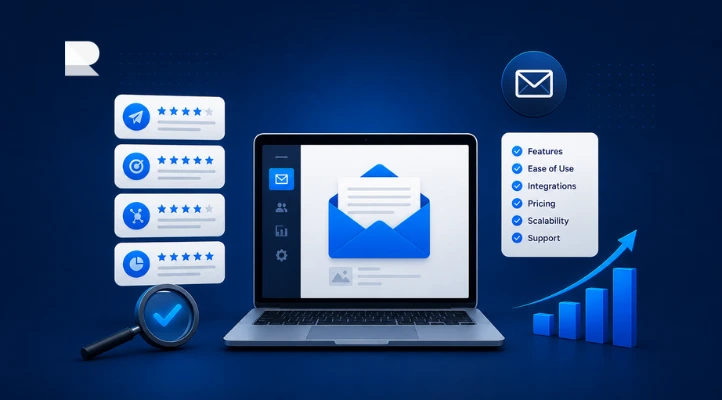
The right email marketing platform for your business comes down to five practical considerations, the real cost at your expected list size, Australian compliance, deliverability, automation capabilities and integrations with the tools you already use. Get these five right and you can usually narrow your shortlist to the platforms that genuinely fit your business.
Here is how to weigh each one, and our head-to-head comparisons once you’re ready to decide between specific platforms.
Start With Price at Your Real List Size, Not the Entry Tier
Every platform looks affordable at the free or entry tier. The real cost differences become clearer once your list grows beyond a few thousand subscribers, which is where pricing structures can vary significantly.
Some platforms price based on list size, regardless of how often you email your subscribers. Others charge based on the number of emails sent, which can suit businesses that send infrequently but become more expensive for frequent campaigns or automated sequences.
Some platforms combine both models or charge extra features such as advanced automation, additional users, or dedicated sending infrastructure.
Before comparing platforms, work out your expected list size over the next 12 months, not just your current subscriber count. Then check pricing at that level in Australian dollars. Most major platforms bill in US dollars, so currency conversion and card fees can add to the actual cost for Australian businesses.
Check Spam Act Compliance, Not Just Unsubscribe Buttons
Australian businesses sending marketing emails need to comply with the Spam Act 2003, which is enforced by the Australian Communications and Media Authority (ACMA).
Compliance goes beyond adding an unsubscribe link. Businesses generally need appropriate consent, must identify themselves correctly, and need to provide a functional way for recipients to opt out of future marketing messages. Unsubscribe requests must also be taken within the required timeframe.
Most major email marketing platforms include tools for consent management, sender identification, and automatic unsubscribe processing. What varies is how much configuration you need to do yourself.
Some platforms may be easier to configure for Australian requirements, while others are built primarily around overseas regulations. That does not automatically make them unsuitable for Australian businesses, but you should check their settings carefully rather than assuming the default configuration covers everything you need.
If your business collects lead through paid advertising, competitions, website forms, or other channels, pay particular attention to how consent is captured and recorded.
For specific compliance requirements, Australian businesses should refer to the current guidance from ACMA rather than relying solely on a platform’s built-in settings.
Deliverability Determines Whether Any of This Matters
A platform can have excellent automation and competitive pricing, but if your emails consistently land in spam, those features will not deliver much value.
Email deliverability depends on several factors, including your sender’s reputation, authentication, email content, list quality, and the infrastructure used by your email platform.
Look for platforms that support proper email authentication methods, including:
- SPF
- DKIM
- DMARC
It should also be reasonably straightforward to configure these records for your domain.
Match Automation Depth to What You Will Actually Use
Email automation can range from a simple welcome sequence to complex customer journeys triggered by browsing behaviour, purchases, website activity or custom events.
More automation does not automatically mean a better platform.
A small business sending a monthly newsletter and a basic welcome sequence does not necessarily need the same capabilities as an ecommerce business running abandoned cart, post-purchase and win-back campaigns.
Before paying for advanced automation, ask:
- What emails do we actually need to automate?
- How much customer data do we have?
- Who will build and maintain the workflows?
- Will the additional features generate enough value to justify the cost?
Integrations Decide How Much Manual Work You Are Signing Up For
Your email marketing platform needs to work with the rest of your digital setup.
At a minimum, consider how it connects with your:
- Website
- Ecommerce platform
- CRM
- Lead capture forms
- Booking systems
- Customer databases
- Analytics and marketing tools
A platform with weak integrations can leave your team manually exporting and importing customer data. That might seem manageable when your list is small, but it can quickly become a recurring administrative task as your business grows.
Check specifically for native integrations with the platforms you already use. Third-party connector tools can bridge some gaps, but they may introduce additional monthly costs and another potential point of failure.
Compare the Platforms Directly
Once you know what matters to your business across these five criteria, you can usually narrow your shortlist to two or three realistic options.
At Rankaholics, Mailchimp is the email marketing platform we offer to Australian businesses, and we have created detailed comparisons to help you understand how it stacks up against other platforms you may be considering:
- Mailchimp vs HubSpot for businesses weighing a dedicated email tool against a broader CRM and marketing platform
- Mailchimp vs MailerLite for businesses comparing value at smaller list sizes
- Mailchimp vs Brevo for businesses that also want SMS marketing in the same platform
- Mailchimp vs Klaviyo for ecommerce businesses weighing automation depth against cost
Each comparison looks at features, automation, integrations and other factors specific to those platforms, helping you understand how they compare once you know what your business needs.
How Rankaholics Can Help
We help Australian businesses get more from Mailchimp, from initial setup through to ongoing email marketing strategy.
Our services include:
- Mailchimp setup and configuration
- List migration and data organisation
- Compliance and consent configuration
- Audience segmentation
- Email automation and customer journeys
- Campaign strategy
- Conversion-focused email marketing
We take the time to understand your business, existing systems and customer journey so your Mailchimp setup supports your goals.
Ready to get more from Mailchimp? Contact Rankaholics today to discuss your email marketing needs and find the right approach for your business.