AI agents are bidding on your ads, but not quite in the way that headline suggests. Autonomous shopping bots are not yet routinely negotiating advertising auctions against each other. The more immediate change is that advertising platforms are handing more decisions about bids, audiences, search matching and creative delivery to machine learning systems.
For Australian businesses using paid advertising, protecting ad spend increasingly depends on what those systems are being told to optimise for. Good automation fed by poor conversion data can simply produce the wrong results faster.
Your Ad Account Is Making More Decisions Without You
Paid advertising has been moving away from manual campaign management for years.
Google’s Smart Bidding uses auction-time signals to optimise bids towards conversion goals. Performance Max extends automation across inventory, audiences and creative, while AI Max adds another automation layer to existing Search campaigns through features including search term matching and asset optimisation.
Starting September 2026, Google has confirmed that campaigns using its broad match setting will be automatically upgraded to AI Max, which means even advertisers who never opted in are being moved further into automated territory.
For businesses running Google Ads, this makes understanding the inputs behind automation more important, not less.
The question is no longer simply, what did we bid for this keyword?
It is increasingly, what outcome did we tell the system was valuable?
Bad Conversion Data Can Become an Expensive Feedback Loop
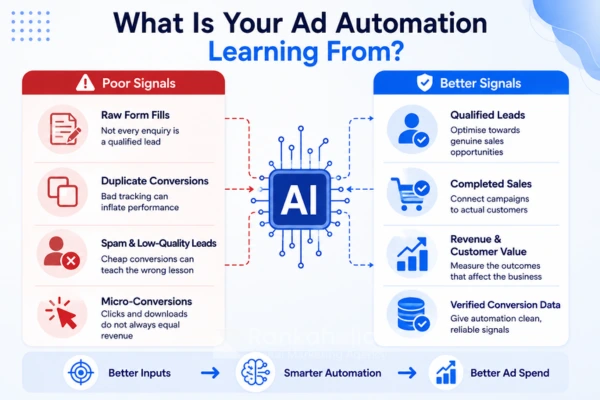
If your Google Ads account records every submitted form as a conversion.
Ten leads arrive. Two are genuine sales opportunities, three are existing customers asking for support and five are spam.
If all ten conversions are sent back to the advertising platform with equal value, the bidding system cannot automatically know which two actually mattered to your business.
It learns from the signal you gave it.
That creates a feedback loop. Automated bidding may find more users who resemble the people generating cheap form submissions, even if those submissions rarely become customers.
The same problem can occur with duplicate conversion events, poorly configured phone tracking, micro-conversions treated as primary goals or sales data that never makes its way back into the advertising platform.
For lead-generation businesses, qualified leads and eventual sales can therefore be much more useful optimisation signals than raw form volume. For ecommerce advertisers, revenue, margins and customer value may tell a more meaningful story than purchase count alone.
This is why our Google PPC advertising service considers conversion tracking and campaign performance together. More conversions are not automatically better if they are the wrong conversions.
Why Ad Fraud Is a Different Problem
It is also important not to confuse advertising automation with ad fraud.
Suspicious clicks, invalid traffic and fraudulent activity are genuine concerns in digital advertising, but they are different from a platform legitimately using machine learning to optimise campaign delivery.
If traffic or conversions suddenly increase without a corresponding improvement in qualified leads, sales or customer value, investigate before deciding what caused it.
Review traffic sources, search terms, placements, geographic patterns, and conversion paths. Check whether tracking has changed and compare advertising-platform results with CRM or sales data where possible.
The Australian Government’s guidance on advertising your business highlights one of digital advertising’s major advantages: businesses can collect data, analyse customer behaviour and measure their marketing activity.
For campaigns running through Meta PPC advertising or Apple PPC advertising, this kind of ongoing review matters more, not less, as each platform pushes further into automated delivery.
Protect Ad Spend by Improving the Signals
Businesses do not need to fight automation. They need better guardrails around it.
Start by identifying which actions actually represent commercial value. A brochure download may be useful, but it should not necessarily carry the same optimisation weight as a qualified enquiry or completed purchase.
Then audit how those actions are measured.
Check that conversions are firing once, phone calls are attributed correctly and important offline outcomes can be connected with their original campaigns where appropriate.
Your landing pages need the same attention. Automated bidding cannot compensate indefinitely for an unclear offer, weak mobile experience or enquiry form that creates unnecessary friction.
Agentic Buying Could Change What Happens Before the Click
The next shift may happen earlier in the journey than the auction itself. If more Australians start using AI agents to research and shortlist businesses before searching manually, brands will need to compete for inclusion in that shortlist, not just for attention once someone reaches a search results page.
That is a different problem to paid automation, but it draws on the same underlying discipline, clear and credible information about your business. We looked at the organic side of this shift in our piece on how search is changing from clicks to answers, which covers how AI-driven search experiences evaluate trustworthiness.
Paid and organic visibility are different channels, but both are starting to reward the same thing, clarity and credibility over volume.
Automation Is Not the Risk. An Unmanaged Account Is
AI-powered advertising is not inherently a threat to your budget. Poorly governed automation is.
The businesses best positioned to protect PPC spend are those that know what their campaigns are optimising towards, connect advertising performance with genuine business outcomes and regularly challenge whether the platform’s version of success matches their own.
That applies whether you are an ecommerce brand chasing profitable sales, a B2B company measuring qualified opportunities or a Perth service business trying to generate better local enquiries.
The objective is not less automation. It is better inputs, stronger oversight and clearer commercial accountability.
Find Out What Your Automation is Actually Optimising For
If your campaigns are increasingly automated but you are not sure what is driving the results, a proper audit is worth more than another dashboard glance. Rankaholics manages PPC campaigns across Google, Meta and Apple with the strategic oversight that automated bidding still needs.
Speak with our team for a PPC audit and find out where your budget is genuinely performing, and where the data behind it might be working against you.