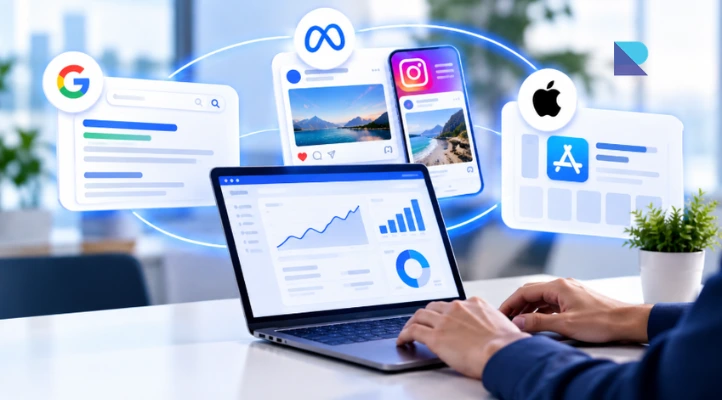
PPC advertising works by letting businesses pay to reach potential customers across platforms such as Google, Meta, and Apple, with campaigns competing for opportunities to show ads to relevant users. Despite the name pay-per-click, the goal is not always simply to buy clicks.
You might be trying to generate enquiries, sales, app installs, or website visits. What matters is reaching the right audience at the right moment, then measuring whether that paid attention turns into something valuable for the business.
For Australian businesses, the differences between the major advertising platforms matter. Google, Meta and Apple all sell paid visibility, but the person seeing your ad may be in a completely different mindset on each one.
Start With What Your Customer Is Doing
Before getting caught up in keywords, audiences or bidding strategies, think about what the potential customer is doing when your ad reaches them.
Someone searching Google for a digital marketing agency in Perth is actively looking for a service. Someone scrolling Instagram may not be searching for anything at all, but the right creative could still catch their attention. Someone searching the App Store for a budgeting app has a different type of intent again.
That difference shapes how each channel works.
Google Search is particularly useful for capturing existing demand. Meta can introduce an offer while people browse Facebook or Instagram. Apple Ads has a more specialised role for businesses promoting apps within the App Store.
Understanding that distinction is a better starting point than choosing a platform simply because your competitors use it.
Google Ads Can Meet Customers While They Are Searching
Google Search ads can put your business in front of people searching for relevant products, services or information.
When an eligible search occurs, Google runs an auction to decide which ads can appear and their position. Winning is not simply a matter of offering the highest bid.
According to Google’s explanation of the Google Ads auction, Ad Rank considers factors including your bid, the quality of your ads and landing page, thresholds, competition, the context of the search and the expected impact of ad assets.
You may also come across Quality Score when reviewing a Google Ads account. Google describes Quality Score as a diagnostic measure based on expected click-through rate, ad relevance and landing-page experience. It can help identify areas worth improving, but the 1-to-10 Quality Score itself is not an input into the auction.
In practical terms, throwing more money at a poorly matched ad and landing page is not necessarily the answer.
If someone searches for a service you provide, the journey from search term to advertisement to landing page should make sense. Businesses looking more closely at this channel can explore how Google PPC advertising works across different campaign objectives.
Meta Ads Has to Earn Attention
Meta advertising starts from a different position.
Someone scrolling Facebook or Instagram may not have expressed an immediate intention to buy what you sell. Your advertisement needs to interrupt that browsing behaviour with something relevant enough to earn attention.
This puts more weight on the combination of audience, creative, offer and landing-page experience.
Meta offers advertising across placements within its platforms. Its information on Facebook and Instagram Reels ads, for example, explains how businesses can advertise within Reels across both platforms.
For a business, this means the advertisement often has to do more of the initial persuasion. Strong creative might introduce a problem the customer recognises, demonstrate a product, communicate an offer or give someone a reason to learn more.
Meta PPC advertising therefore deserves its own strategy rather than simply copying what works in Google Search.
Apple Ads Is Built for App Discovery
Apple Ads belongs in the PPC mix, but its role is much narrower.
It is designed for businesses promoting apps within the App Store. If you operate an app-based business, that puts your advertising close to users who are already browsing or searching for apps. If you run a local plumbing company, it is probably not the channel keeping you awake at night.
Apple supports different App Store advertising placements and bidding options. Its Apple Ads bidding guidance explains that Manage Bids campaigns can use a maximum cost-per-tap bid, while Maximise Conversions search-results campaigns use automated bidding.
Apple also notes that the actual amount paid can be lower than the maximum bid and is influenced by factors including relevance and competition.
That makes Apple Ads a specialised part of the PPC landscape rather than a direct substitute for Google or Meta in every campaign.
Businesses promoting apps can look more closely at Apple PPC advertising and how App Store campaigns fit into their acquisition strategy.
Your Bid Is Only as Useful as the Goal Behind It
Modern PPC platforms increasingly use automation to decide when, where and to whom advertisements appear.
That can make advertising more efficient, but automation still needs a meaningful objective.
Suppose your campaign is designed to generate qualified enquiries. If your conversion tracking records every form submission as a success without distinguishing genuine prospects from spam or poor-quality leads, the platform is working with an incomplete picture.
This is where conversion tracking becomes essential. It connects ad activity with actions that matter, such as enquiries, purchases, bookings or app installs.
Attribution adds another layer by helping you understand how different advertising interactions contributed to a conversion. A customer may click an ad today, return through another channel later and only then make an enquiry.
The numbers therefore need context.
We look more closely at automated bidding and conversion signals in AI automation and PPC ad spend, rather than trying to squeeze that much larger subject into this PPC overview.
Cheap Clicks Do Not Automatically Mean Good Advertising
PPC platforms give you plenty of metrics, but not all of them tell you whether the advertising is actually helping the business.
Impressions show how often an ad was displayed. Click-through rate shows how frequently people clicked after seeing it. Cost per click tells you what those visits cost.
Once you move closer to commercial outcomes, cost per acquisition (CPA) becomes particularly useful. It tells you how much advertising spend is required to generate a defined conversion or customer action.
Even CPA needs context.
A campaign generating 100 cheap enquiries is not necessarily outperforming one generating 30 if most of those 100 leads never become customers. Ecommerce businesses may look at return on ad spend, but margins, repeat purchases and customer lifetime value can change what profitable performance actually means.
Budget deserves the same context. Rather than repeating that subject here, the factors involved in setting a Google Ads budget for Australian SMBs are covered separately.
The Right Channel Depends on How People Find You
There is no single PPC channel that suits every Australian business. Google Search can capture existing demand, Meta can reach people while they browse, and Apple Ads has a specific role for businesses promoting apps.
The right mix depends on where your customers spend their time, what they are doing when your ad reaches them and what action you want them to take. Just as importantly, you need to be able to track whether those clicks, enquiries or conversions are actually delivering value.
That is PPC without the platform jargon. You are paying for relevant attention, then using targeting, bidding, creative and measurement to turn that attention into a meaningful business result.
If you are working out where paid advertising fits into your digital strategy, discuss your paid advertising options with Rankaholics to find out which channels make sense for your audience, objectives and business.