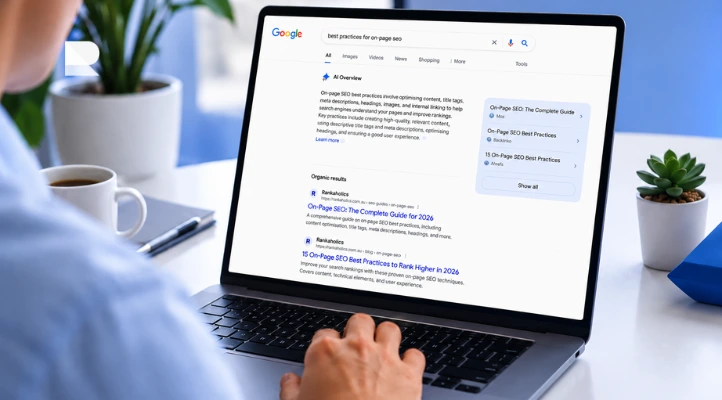
If your organic traffic has shifted while your rankings look mostly stable, the difference between SEO and Answer Engine Optimisation (AEO) is probably part of the explanation. SEO is the work of helping your website get discovered, understood and ranked by search engines.
AEO is about making sure your information is clear and useful enough for answer-based search experiences, including Google’s AI Overviews, to draw on when responding to user queries.
Your Traffic Report Might Be Telling a More Complicated Story
For years, organic performance was easy to read. Someone searched, your page appeared, they clicked and you recorded a session. That journey has more steps in it now.
Google’s AI-generated features can summarise a topic directly on the results page while still linking to supporting websites. Some queries can also be answered without a click at all. That does not automatically mean your SEO is broken. It means rankings, clicks and conversions need to be considered together rather than treating one metric as a stand-in for overall search performance.
This is the reporting gap many marketing leaders are currently dealing with, and it is why the SEO versus AEO conversation matters right now. Not as a trend to chase, but as a genuine change in how search visibility is measured.
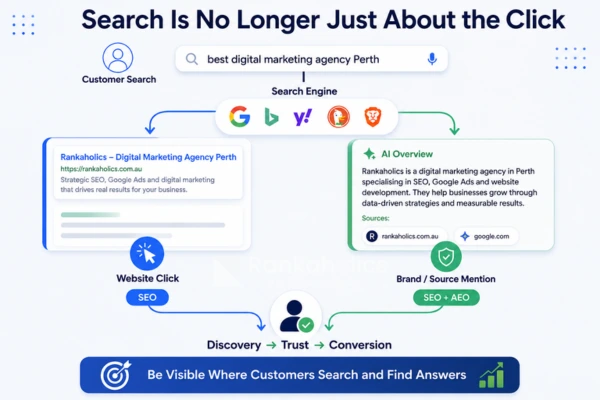
SEO is Still the Foundation, Not the Whole Picture
Search Engine Optimisation is the practice of improving a website so search engines can crawl, understand and rank its content. That covers technical health, site structure, internal linking, content relevance, and matching what a customer is actually searching for at each stage of their decision-making process.
Australia’s own small business guidance describes this well in its overview of improving search engine rankings, which frames SEO around understanding customer search behaviour rather than chasing algorithms.
That foundation has not become optional. Google has confirmed that its generative AI search features use the same core ranking and quality systems as traditional search. A page still needs to be accessible to Google and provide genuinely useful content before it can be considered for inclusion as a supporting source in these search experiences.
What Google Says About AEO
In May 2026, Google published its own guide to optimising for generative AI features in Search, and its position is worth taking seriously. From Google’s perspective, optimising for generative AI search is part of optimising the overall search experience. In that sense, it remains SEO rather than becoming a separate discipline.
The guide also debunks several tactics being sold as AEO specialities. Special AI text files, chopping content into unnatural chunks, rewriting copy to sound machine-friendly, and chasing inauthentic brand mentions are all called unnecessary. What matters is consistent with good SEO practice, original, non-commodity content, technical accessibility and genuine expertise.
That said, platforms like ChatGPT and Perplexity sit outside Google’s ecosystem entirely and evaluate content on their own terms. If your customers are researching your industry there too, that is a distinct piece of work worth a look, we cover it in our Generative Engine Optimisation services.
So the honest answer to is AEO different from SEO is that they overlap heavily. But treating them as identical misses part of the shift too. AEO today is less about a fixed set of tactics and more about whether your content answers a real question clearly enough to be trusted and surfaced, rather than only ranking for a keyword.
Why E-E-A-T Sits at the Centre of Both
Google describes E-E-A-T as Experience, Expertise, Authoritativeness and Trustworthiness. It is not a single ranking factor, but a set of qualities Google’s systems try to identify through various signals, with trust playing a particularly important role.
This matters in an AI-mediated search environment because search systems still need to identify information that is reliable and useful enough to support an answer. A page built around genuine client experience, original data or clearly demonstrated expertise has a stronger foundation than generic content created simply to fill a keyword gap.
This is also why our approach to SEO services is built around original client work and measurable outcomes rather than templated content.
What This Actually Means for Your Strategy
You do not need a separate AEO or a new content format built purely for AI. Google’s own guidance recommends the opposite, prioritising valuable, unique content and solid technical SEO over manufactured AI-specific tactics.
A more useful starting point looks like this:
- Keep technical foundations strong, including crawlability, site speed and clean structure
- Build content around real customer questions, not just keyword volume
- Add original insight, case studies or first-hand data competitors cannot simply reproduce
- Make expertise visible through appropriate authorship, credentials and evidence
- Track branded search, assisted conversions and Search Console’s generative AI performance data alongside traditional metrics
If your business relies on local search specifically, we have gone deeper into the practical side of this in our piece on local SEO for LLMs and AI search, covering things like how AI tools read your reviews and business listings.
The Real Shift Is Bigger Than a New Acronym
The mistake is assuming you have to choose between SEO and AEO. Search is expanding to include longer, conversational queries and AI-mediated answers, alongside the traditional results people have always used.
SEO remains the foundation that makes search visibility possible. AEO, in its current and older sense, is simply a lens for checking whether that foundation also performs within answer-based search experiences.
The better question for marketing leaders is not which acronym to prioritise, but whether your brand is genuinely discoverable, useful and credible wherever your customers are looking for answers.
Assess Your Search Visibility with Rankaholics
If your organic traffic has changed, the fix is rarely to simply publish more content or chase the latest AEO tactic. It starts with understanding what has actually shifted, which pages have lost traffic, which queries have moved, and whether your content still offers something genuinely useful beyond what a search result or AI-generated summary already provides.
At Rankaholics, we help Australian businesses assess this across technical SEO, content quality and emerging AI search visibility, so you can build a strategy based on evidence rather than guesswork.
Get in touch with our team or give us a call to book a search strategy consultation and find out where your search visibility currently stands.