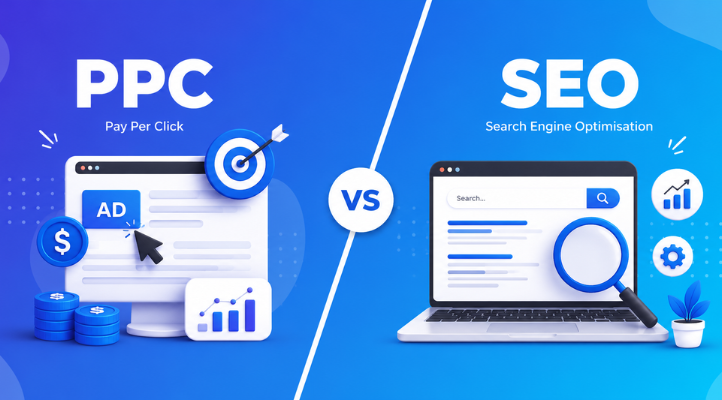
In digital marketing, businesses often ask a timeless question: is PPC better than SEO, or vice versa? With the right strategy and clear goals, PPC and SEO aren’t opposing options, they can work together. Many marketers find that a balanced mix of Google PPC Advertising and solid SEO advertising yields the strongest overall results.
What’s the Difference Between PPC and SEO?
If you’re launching a new product, promoting a seasonal sale, or trying to outperform competitors in a crowded market, understanding the pros and cons of PPC and SEO is essential. PPC offers immediacy and measurable impact, while SEO provides long-term credibility and sustainable traffic.
By examining cost, speed, control, and long‑term value, you can decide where to invest first and how to allocate budget across Google PPC and SEO advertising.
What is PPC and How Does It Work?
Pay-per-click advertising, is a model where you pay each time someone clicks your ad. Google ppc ads appear at the top or above organic results, giving you prime real estate on search engine results pages (SERPs). Key advantages include:
- Instant visibility: Your ads can appear as soon as campaigns go live.
- Precise targeting: You can tailor keywords, location, device, and audience demographics.
- Measurable ROI: Every click is trackable, enabling rapid optimization.
For many Australian businesses, Google PPC advertising offers a powerful way to capture high-intent traffic, especially during promotions or product launches. The main trade-off is cost volatility and dependency on bidding dynamics.
What is SEO and How Does It Work?
SEO, or search engine optimization, focuses on improving organic rankings through content quality, technical health, and user experience. SEO advertising in a broader sense refers to the practice of driving traffic through non-paid search results, but we’ll emphasize the long-term value of organic optimization.
Core components include:
- Content relevance: Creating topics and answers that satisfy user intent.
- Technical health: Ensuring fast page speed, mobile-friendliness, structured data, and crawlability.
- Earning authority: Building inbound links, trustworthy signals, and brand recognition.
The payoff for SEO marketing advertising is lasting visibility. Once you rank well, you can maintain steady traffic with relatively lower ongoing costs compared to ongoing PPC spend. However, SEO results typically take longer to materialize, especially for competitive keywords.
Paid Ads vs Organic Growth Explained
Think of Google PPC advertising like renting a billboard on the highway. The moment you pay for the spot, thousands of drivers see it. The moment you stop paying, it goes dark. Organic SEO is more like building a coffee shop in that same area — it takes time and effort to get established, but once locals know you’re there, they keep coming back without you spending a cent on the billboard.
Both approaches show up on the same Google results page, but they behave very differently:
| Factor | Google PPC Ads | SEO (Organic) |
| Time to results | 7 days | 3–6+ months |
| Traffic longevity | Stops with budget | Compounds over time |
| Ongoing cost | Cost per click | Content and tech investment |
| Click-through rate | ~2–5% (paid) | Up to 28–30% (position 1) |
| Trust signal | Moderate (labelled “Sponsored”) | Higher (earned placement) |
| Best for | Campaigns, launches, promotions | Evergreen traffic, authority building |
A balanced strategy often allocates a portion of the budget to google ppc ads for immediate visibility and reserve ongoing funds for SEO advertising initiatives that build durable traffic over time.
- PPC advantages: Control over messaging, landing pages, and bidding, fast tests; clear attribution to conversions.
- SEO advantages: Sustainable traffic and trust; higher click-through potential from organic results; less reliance on paid channels.
However, PPC requires ongoing spend and can be vulnerable to budget cuts or platform changes. SEO, while more cost-efficient in the long run, depends on algorithm updates and competition in your niche.
Which Delivers Faster Results?
This is where the distinction between PPC and SEO becomes most apparent.
- PPC: Fast to start, fast to stop. You can generate traffic within hours of launching a campaign, and you can scale quickly by increasing budget or refining targeting. For campaigns with time constraints, product launches, or events, google ppc ads are often the go-to solution.
- SEO: Slow to build, quick to scale in the long run. SEO advertising benefits from compounding effects; content gains momentum, authority improves, and rankings improve over weeks to months. Once established, organic traffic tends to be more stable and cost-efficient over time.
In practice, many Australian businesses use PPC to bridge the gap while SEO matures. For example, you might run google ppc advertising during a launch window to capture early demand while you publish and optimize SEO content to target evergreen and long-tail keywords.
Which is Better When Your Budget is Tight?
If you have a small or fixed marketing budget, here’s how to think about it:
1. Short-term survival (under 3 months): Prioritise Google PPC advertising. A well-targeted campaign on even 500–1,500 AUD/month can generate immediate leads, giving you cashflow while you invest in longer-term assets.
2. Medium-term growth (3–12 months): Start shifting budget toward SEO advertising. Invest in content, fix technical site issues, and build local citations. You’re planting seeds that reduce dependence on paid ads over time.
3. Sustainable long-term (12+ months): A strong SEO foundation dramatically lowers your cost-per-lead. At this stage, Google PPC ads become amplifiers — used for promotions, testing, and capturing seasonal spikes rather than your primary source of traffic.
How to Combine PPC and SEO Advertising for Maximum Results
The most successful digital marketing strategies in Australia don’t pick sides as they use Google PPC ads and organic SEO to reinforce each other.
Here’s a proven approach:
Start with a Quick PPC Sprint
- Run google ppc ads for 2–4 weeks to validate keywords, headlines, and offers.
- Use immediate data to identify which keywords convert and which landing pages perform best.
Launch and Optimise SEO Advertising in Parallel
- Create high-quality content targeting your core topics and buyer intents.
- Improve technical factors (site speed, mobile usability, schema markup) to support rankings.
- Build a content plan that targets both short-tail and long-tail keywords for lasting visibility.
Create a Feedback Loop
- Use PPC data to refine SEO: identify high-performing phrases and search intents that deserve content expansion.
- Use SEO insights to improve PPC landing pages, quality scores, and ad relevance.
Allocate budget strategically
- Reserve a steady PPC budget for ongoing visibility during campaigns or promotions.
- Invest in SEO advertising for evergreen traffic and brand authority.
Take the Next Step
Is PPC better than SEO? Our honest answer will depend on your goals, timeline, and resources. PPC provides instant visibility and granular control, making it ideal for promotions, launches, and aggressive testing. SEO advertising, while slower to ramp, builds durable traffic, authority, and cost-efficiency over time.
The most effective approach for many Australian businesses is a blended strategy that leverages the immediate impact of PPC with the long-term sustainability of SEO.
Rankaholics works with Australian businesses to build search strategies that deliver both immediate results and long-term growth. Whether you need help with Google PPC advertising, SEO, or both, we’ll tell you straight what’s going to move the needle for your business. Contact us for a free consultation today!