AI trust signals are the specific, verifiable markers, such as sourced statistics, third party mentions and original evidence, that large language models use to decide which brands are credible enough to cite in an answer. They are not keywords, and they are not backlinks in the traditional sense. Peer reviewed research now shows how much they matter, and this article breaks down exactly what that research found.
If you are after the practical playbook for getting your local business recommended by AI tools, our guide on optimising your local business for LLMs and AI search covers that in detail. We’ll look at the research underneath those tactics, so you understand why they work before you spend time implementing them.
What the GEO Study Revealed About AI Citations
In 2024, researchers from Princeton University, Georgia Tech, IIT Delhi and the Allen Institute for AI published a study called Generative Engine Optimisation, presented at the KDD conference. The researchers coined the term GEO to describe optimising content specifically for AI-generated search results, rather than traditional search engines. It is the first large-scale academic attempt to test what actually improves a piece of content’s odds of being cited inside an AI generated answer.
They built a benchmark of ten thousand real user queries spanning nine topic areas, then tested nine separate content changes against a generative search system designed to mimic Bing Chat, later validating the strongest results on Perplexity.
The outcome was significant. Across the researchers’ benchmark, certain content improvements increased visibility in AI-generated responses by up to 40%, depending on the query and optimisation technique tested. The three strongest levers were adding sourced statistics, including credible quotations and citing reliable outside sources. Improving the readability and fluency of the writing produced a meaningful lift on its own too.
Just as telling what did not work. Keyword stuffing, still a habit in a lot of SEO workflows, had no meaningful benefit and in some cases hurt visibility. That is a useful data point for any business still treating AI search as a variation of Google rankings rather than something with its own rules.
Fact Density Matters More Than Keyword Repetition
Traditional search engines built their ranking systems around matching words. If your page repeated the right phrase enough times in the right places, it had a shot at ranking.
Large language models do not work that way. They evaluate content based on what researchers call information gain, essentially whether a passage adds something genuinely new and specific to what the model already understands about a topic, rather than repeating it in different words.
This ties back to how LLMs represent meaning internally, through vector embeddings that map concepts by relevance rather than literal word matches. A page dense with concrete facts, figures and specifics sits in a stronger position in that internal representation than a page that is technically on topic but says very little of substance.
In practice, a paragraph built around one precise, sourced figure will usually outperform a paragraph built around a vague claim, even if both are the same length and cover the same subject. Specificity is doing the work that keyword density used to do.
Unlinked Brand Mentions Are Being Counted As Evidence
One of the more counterintuitive findings in this space concerns brand mentions that carry no link back to your website at all.
Traditional SEO treats backlinks as the main currency of trust. AI systems appear to function as supporting evidence of credibility, sometimes called co-citation, where a brand name appearing alongside credible context on Reddit threads, local forums, review platforms or third party media is treated as a form of independent verification, whether or not that mention links anywhere.
The logic holds up once you consider how these systems are built to assess trust. A link can be manufactured. A brand being discussed naturally across unrelated, independent platforms is much harder to fabricate at scale, which is likely why it carries weight as a genuine credibility signal rather than a manipulated one.
Industry research points in the same direction. NP Digital’s analysis surveyed 100 marketers, asking them to rate the importance of seven trust signals across Google AI Overview, ChatGPT, Gemini, Copilot, Claude and Perplexity.
The results showed clear differences in how SEO marketing specialists believe each platform values trust signals:
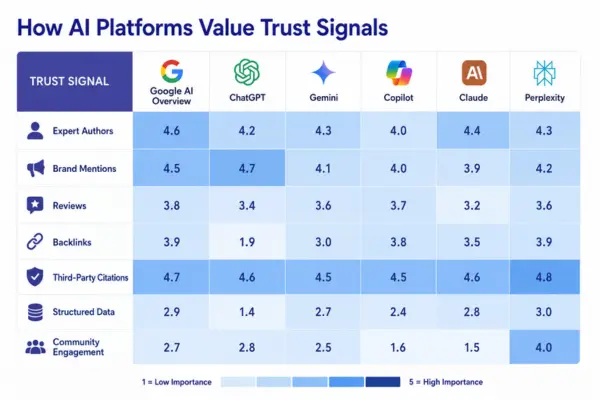
- Third-party citations ranked highest across every platform, receiving scores between 4.5 and 4.8, including 4.8 for Perplexity and 4.6 for both ChatGPT and Claude.
- Backlinks received much more varied ratings, scoring 3.9 for Google AI Overview and Perplexity, but just 1.9 for ChatGPT.
- Community engagement also varied considerably, ranging from 4.0 for Perplexity to 1.5 for Claude and 1.6 for Copilot.
While these findings reflect practitioner perceptions rather than direct platform data, they reinforce the view that AI platforms may prioritise different trust signals when selecting sources.
Separate research from Semrush identified Quora as the most cited site in Google AI Overviews, reinforcing that community and forum discussion carries real weight even without a direct link back to your site.
This is the research basis behind advice you may have seen elsewhere on our site about earning mentions in industry publications, local news and community discussion, rather than chasing links as the only goal. The mention itself is doing more work than most businesses realise.
Multi-Modal Trust Signals Can Get Your Content Selected More Often
The latest shift in generative search involves pages that combine multiple verifiable content types on a single URL.
Because engine models like Google Gemini are inherently multimodal, they evaluate visual and textual assets simultaneously. Pages that pair structured text with direct, attributable quotations, verifiable stats, and original photography (rather than generic stock images) provide stronger overall trust signals than single-element pages.
This does not mean every piece of content requires video or interactive diagrams. However, backing up a written claim with concrete, original proof, a genuine client quote, a custom data chart, or an authentic photo, gives AI search engines more grounds to extract and cite your page as a reliable source.
What This Means If You Are Publishing Content For AI Search
None of this replaces good SEO fundamentals, and it is not a shortcut. What the research shows is that AI systems reward content that behaves like genuine expertise looks in the real world. Specific over vague. Verifiable over asserted. Referenced by others over self promotion.
Understanding why AI trust signals matter is only the first step. The next is putting them into practice by creating content and building a brand that AI systems recognise as credible. If your goal is to be recommended by tools like ChatGPT and Gemini when customers ask for local businesses, read our guide on how to get ChatGPT and Gemini to recommend your local business.
At Rankaholics, we help Australian businesses build content and digital strategies grounded in how these systems work, not guesswork. Get in touch with our team if you want a clearer picture of where your brand currently stands in AI search.