
Before you redesign your website, the smartest first move is not a new homepage. It is identifying what is actually holding your current site back.
A dated appearance may be part of the problem, but weak conversion paths, unclear content, technical issues, accessibility gaps or a poorly managed website migration can cause far more damage.
Auditing these areas first gives your redesign a clear business purpose while helping protect the traffic, leads and search visibility your existing website has already earned.
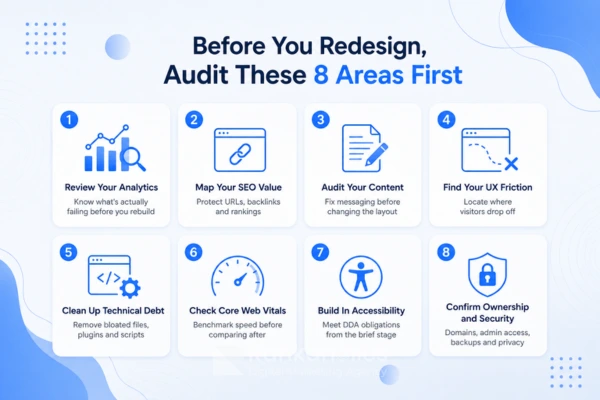
Start With Evidence, Not a New Homepage
Most website redesign conversations begin with appearance. The site looks old, a competitor has launched something sharper, or the brand has outgrown its current design.
Those observations may justify change, but they do not tell you what actually needs fixing.
Before briefing a designer, define what the current website is failing to do:
- Are qualified enquiries too low relative to your traffic?
- Are important services or products difficult to find?
- Do visitors reach key pages but stop before taking action?
- Where does your conversion funnel lose the most potential customers?
Reviewing the existing site against real business outcomes separates genuine problems from cosmetic preferences. It also gives the redesign a measurable brief instead of simply a new look.
Protect the Data and SEO Value You Have Already Earned
An established website carries valuable digital equity built through content, backlinks, rankings and user behaviour. A poorly managed rebuild can unintentionally lose some of that value.
Before development begins, document the conversion events that matter, including form submissions, phone clicks, bookings, purchases and other lead actions. Check how tools such as GA4, Google Tag Manager and advertising pixels are currently configured so tracking can be tested and validated on the new website.
SEO needs the same attention.
Changing URLs, navigation, page content and internal links simultaneously can affect how search engines crawl and understand the site. Use Google Search Console and your SEO tools to record important organic landing pages, existing URLs, backlinks, title tags and internal links before anything is removed or restructured.
If URLs need to change, create a redirect map before launch rather than dealing with broken pages and lost traffic afterwards.
Our technical SEO services look at site architecture, crawlability, redirects, performance and other technical issues that can affect search visibility during major website changes.
Fix Content and Friction Before You Touch the Layout
A new template cannot rescue unclear content.
Review your main pages and ask whether a potential customer can quickly understand what you do, who you help, why they should choose you over a competitor and what they should do next.
This is particularly important for service businesses where pages may have accumulated over several years. Thin, duplicated or outdated pages should not automatically be migrated simply because they already exist.
Decide deliberately which content should be retained, improved, consolidated or removed.
Then look at user friction. Heatmaps and session recordings from tools such as Microsoft Clarity or Hotjar, combined with analytics funnels and enquiry data, can help identify where visitors hesitate or leave.
If users consistently reach a service page but fail to enquire, changing the colour palette is unlikely to solve the underlying problem. The redesign needs to address the offer itself, content hierarchy, trust signals and conversion path, not just the visual layer.
Clean Up Technical Debt Before It Follows You Into the New Build
A redesign is an opportunity to remove technical baggage instead of rebuilding around it.
Audit oversized images, unused media, unnecessary plugins, outdated integrations, third-party scripts and old functionality. Every component that moves into the new website should have a reason to be there.
Establish a performance baseline as well. Record your current Core Web Vitals and test representative pages on mobile and desktop so you have something meaningful to compare against after launch.
Performance should still be considered in context. As we explain in our guide to page speed, conversions and search rankings, the goal is not simply to chase a perfect performance score. A fast website still needs useful content, intuitive navigation and clear conversion opportunities if it is going to generate leads.
Build Accessibility Into the Brief, Not the Final Task List
Accessibility should be considered from the beginning of a website redesign rather than treated as a final development task.
The Australian Human Rights Commission provides guidelines on equal access to digital goods and services in the context of Australia’s Disability Discrimination Act 1992. Accessibility considerations can include areas such as colour contrast, keyboard accessibility, page structure and accessible forms.
Building accessibility into the design and development process from the start can also be more efficient than identifying and retrofitting accessibility problems after launch. More accessible design can improve usability for a wider range of visitors while reducing barriers that may prevent people from using your website effectively.
Confirm Ownership, Security and Privacy Before Anything Moves
A redesign often involves new developers, hosting arrangements and administrator access. That makes it a good opportunity to confirm who controls your domain, hosting, CMS, analytics and other important accounts, while removing access that is no longer required.
Review basic website security measures as part of the process, including multi-factor authentication where available, HTTPS, appropriate user permissions, software updates and reliable backups.
If your website collects personal information through forms, accounts, or other functionality, the redesign is also a sensible time to review your privacy practices. Do not automatically carry old forms, integrations, and tracking configurations into the new website without checking what information they collect and whether they are still required.
Decide What Actually Needs Rebuilding
Not every website problem requires a complete rebuild.
Sometimes a targeted page redesign, content restructure, conversion improvement or technical cleanup can address the underlying problem without replacing the entire website.
A full rebuild may make sense when the existing CMS, technology or site architecture is genuinely limiting what the business needs the website to do. If you are unsure which approach suits your website, our guide to business website design services explains the different approaches and what they involve.
The decision also has a significant effect on budget. Our guide to website development pricing in Australia explains some of the factors that influence development costs, because improving an existing website and rebuilding one from the ground up are very different projects.
Turn the Audit Into the Actual Redesign Brief
The strongest website redesigns do not begin with a blank screen. They begin with a clear picture of what already works, what needs to be preserved and what genuinely needs to change.
Use the findings from your analytics, SEO, content, user experience, technical performance, accessibility and account review to create the redesign brief. That gives your designers and developers actual problems to solve and provides benchmarks you can compare against after launch.
The objective is not simply to make the website look newer. It is to build a site that protects the value you have already created while making it easier for the right visitors to find your business, understand your offer and take the next step.
Get a Free Website Audit Before You Commit to a Redesign
At Rankaholics, our website design and development services are built around the wider role a website plays in digital marketing. If you are considering a redesign, contact the Rankaholics team to identify what should be fixed, preserved or rebuilt before development begins.